A plumbing firm in Leeds can rank well in Google Maps and still miss valuable enquiries from people searching for boiler installation, emergency repairs, or landlord certificates. The reverse is also true. A business can have decent organic rankings but weak visibility in the map pack, which means fewer calls from people ready to book now. That is why Google Maps vs organic SEO is not a niche marketing debate. It affects how local customers find you, compare you, and decide whether to get in touch.
For service-based businesses, the real question is not which channel is better in the abstract. It is which one drives the right kind of visibility for your services, locations, and buying cycle. Google Maps and organic SEO serve different purposes, and the strongest local growth usually comes from treating them as connected, not competing.
Google Maps vs organic SEO: what is the difference?
Google Maps visibility is largely driven by your Google Business Profile and local ranking signals. When someone searches for a service with local intent, Google may show the local pack - usually three map listings with reviews, business details, and quick actions such as call, directions, or website visit. This is high-intent territory. These users often want a nearby provider and want one quickly.
Organic SEO refers to the standard website results beneath the map pack. These rankings depend more heavily on your site structure, service pages, content relevance, technical SEO, internal linking, metadata, and authority signals. Organic results usually give you more room to explain what you do, where you work, and why someone should choose you.
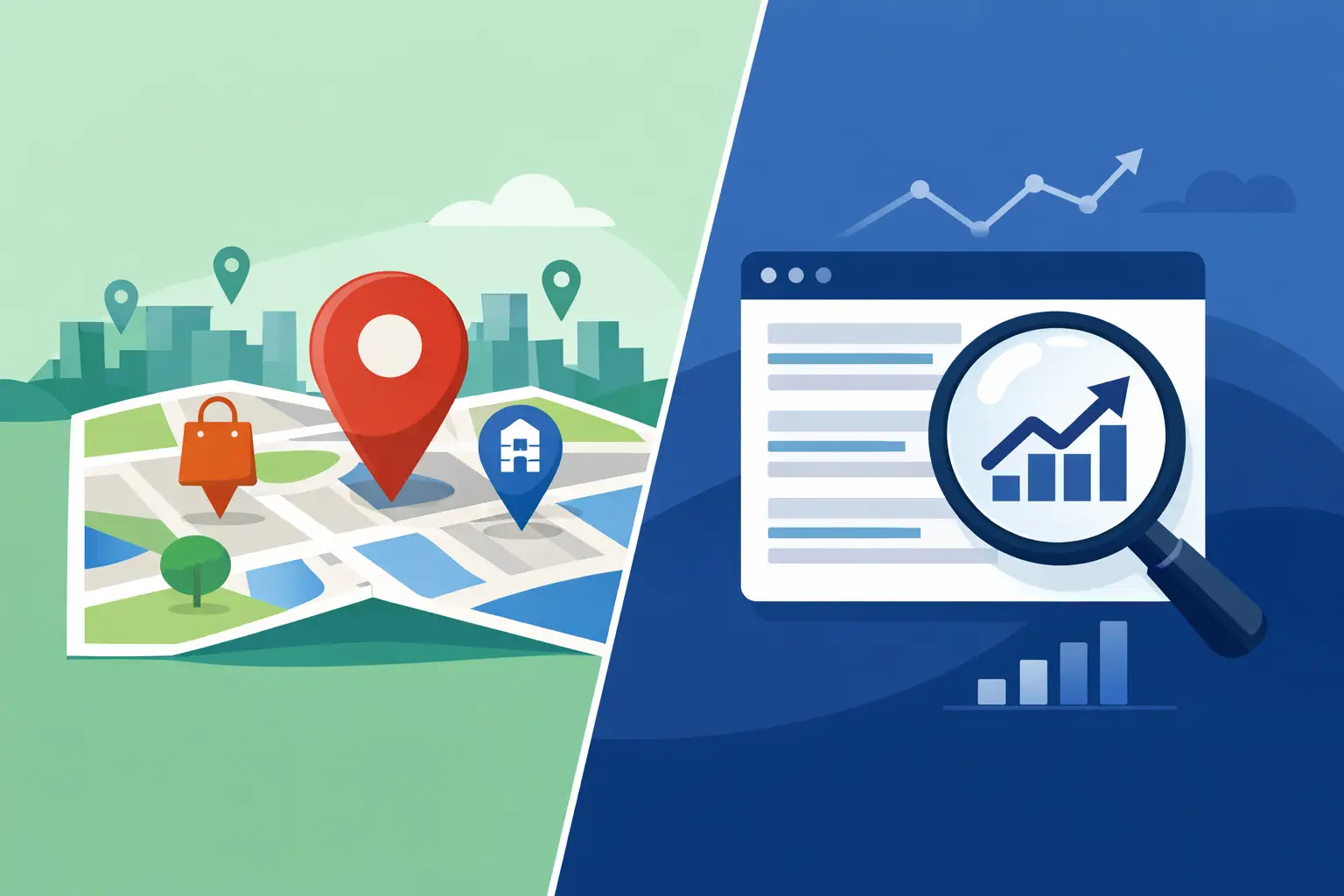
In plain terms, Google Maps helps you win visibility inside Google’s local business layer. Organic SEO helps your website rank as a strong answer to a search query. Both matter, but they do different jobs.
When Google Maps matters most
If your business depends on phone calls, urgent bookings, or customers choosing from a shortlist, Google Maps can have a direct impact on lead flow. Searches such as electrician near me, emergency locksmith, roofing company Bristol, or denture repair Glasgow often trigger local pack results because Google sees immediate local intent.
In those cases, a strong Google Business Profile can drive fast actions. Reviews, opening hours, service categories, proximity, and profile completeness all influence whether someone clicks or calls. Maps visibility is often strongest for searches where the user wants a local provider now rather than a long research process.
This is especially important for businesses with one physical base or a clearly defined service area. If you rely on nearby demand, Maps can become one of the quickest ways to generate qualified enquiries.
That said, Google Maps has limits. You have less control over how your listing appears than you do with your website. You are also competing in a tight visual space where review volume, review quality, relevance, and location signals can shift performance quickly. If your profile is weak, incomplete, or poorly categorised, visibility can stall even if your business is excellent.
When organic SEO matters more
Organic SEO becomes critical when searches are more specific, more competitive, or tied to service detail. Someone searching for commercial drainage contractors, probate solicitor for estate dispute, or air source heat pump installation cost is often looking for more than a nearby listing. They want information, proof, and a business that clearly matches their needs.
That is where your website has the advantage. Well-built service pages can target exact services, locations, use cases, and customer questions. You can structure pages around search intent, explain your process, show trust signals, and guide people towards an enquiry.
Organic SEO also gives you broader reach than Maps alone. You can rank for problem-led searches, comparison searches, and location-service combinations that a Google Business Profile will not cover in much depth. For businesses serving multiple towns or offering several specialist services, this is often where growth comes from.
There is another practical point. Your website supports visibility beyond Google’s standard results. Strong page structure, schema, internal linking, and clear service information also help AI-driven search tools understand your business properly. That matters more every year.
Google Maps vs organic SEO for lead quality
Not all clicks are equal. Maps traffic often converts well because the intent is immediate. A person clicking call from a map listing may already be close to booking. This is one reason local businesses value map pack visibility so highly.
Organic traffic can be just as valuable, but it tends to play across more stages of the journey. Some users are ready to enquire. Others are comparing options, checking service coverage, or validating trust. That means organic SEO often supports both demand capture and decision-making.
If your sales cycle is short, Maps may look stronger at first glance. If your service requires explanation, carries a higher value, or involves multiple decision-makers, organic often plays a bigger role. Neither channel should be judged by traffic alone. The better question is which one produces the right enquiries.
Why businesses struggle when they choose only one
A common mistake is treating local SEO as if it begins and ends with Google Business Profile optimisation. Another is putting all effort into website rankings while neglecting Maps entirely. Both approaches leave opportunities on the table.
If you focus only on Maps, you may appear for branded and near-me searches but miss commercial organic terms that show clear buying intent. You also become more dependent on one listing and one result type.
If you focus only on organic SEO, you risk losing visibility where local users make quick decisions. In some sectors, the map pack absorbs a large share of clicks before users even reach standard website results.
The stronger approach is to build local relevance across both layers. Your Google Business Profile should be accurate, complete, and aligned with your website. Your website should have clear service pages, location relevance, strong indexing signals, and technically sound foundations. These elements reinforce each other.
How Google Maps and organic SEO overlap
Although they are different systems, Maps and organic SEO are not isolated. Google uses multiple signals to assess local relevance and business legitimacy. That means your website still influences local performance, and your local presence can support organic trust.
For example, if your service pages clearly explain what you do and where you do it, that helps search engines understand local relevance. If your Google Business Profile points to a strong, relevant landing page instead of a vague homepage, user experience usually improves. Consistent business details, proper site structure, crawlability, schema, and useful content all support clearer visibility.
Reviews also create overlap. They mainly sit within your Google Business Profile, but they influence trust across the journey. A user may find you in organic results and then check your reviews before making contact. Local SEO works best when these touchpoints support one another rather than sending mixed signals.
What should a local business prioritise first?
It depends on your starting point.
If your Google Business Profile is unclaimed, poorly optimised, or missing key information, fix that first. It is usually one of the fastest wins for a local business. Categories, services, business description, photos, review strategy, and landing page choice all matter.
If your profile is decent but your website has thin service content, weak location targeting, poor metadata, or technical issues, organic SEO likely deserves more attention. Many businesses cap their growth because Google can see the business exists but cannot clearly understand its services, service areas, or commercial relevance.
For most service businesses, the best route is not to pick a winner between Google Maps vs organic SEO. It is to identify the bottleneck. Sometimes that bottleneck is profile optimisation. Sometimes it is weak site architecture. Sometimes it is a lack of location-specific service pages. Sometimes it is technical clutter that hurts crawlability and indexing.
At Input Marketing, this is usually where the conversation starts - not with vanity rankings, but with how a business actually gets found and chosen by local customers.
The commercial view: visibility should match search intent
If someone searches emergency plumber near me, they may never read a long article or browse several pages. They want speed, trust, and a clear contact route. That is a Maps-led opportunity.
If someone searches office fit-out contractor Manchester or how much does a loft conversion cost, they are more likely to compare providers, read service details, and assess fit. That is where organic SEO carries more weight.
The point is simple. Search visibility should match customer intent. Businesses that understand this tend to invest more intelligently. They stop asking which channel is universally better and start asking which combination produces more calls, more form fills, and better-quality enquiries.
A local SEO strategy should reflect how your customers actually search, not how a platform labels its results. If your business needs stronger local visibility, stronger lead quality, and better coverage across both Google Search and emerging AI-driven discovery, the smartest move is usually to tighten the connection between your Google Business Profile and your website. When both are working properly, you are easier to find, easier to trust, and easier to choose.