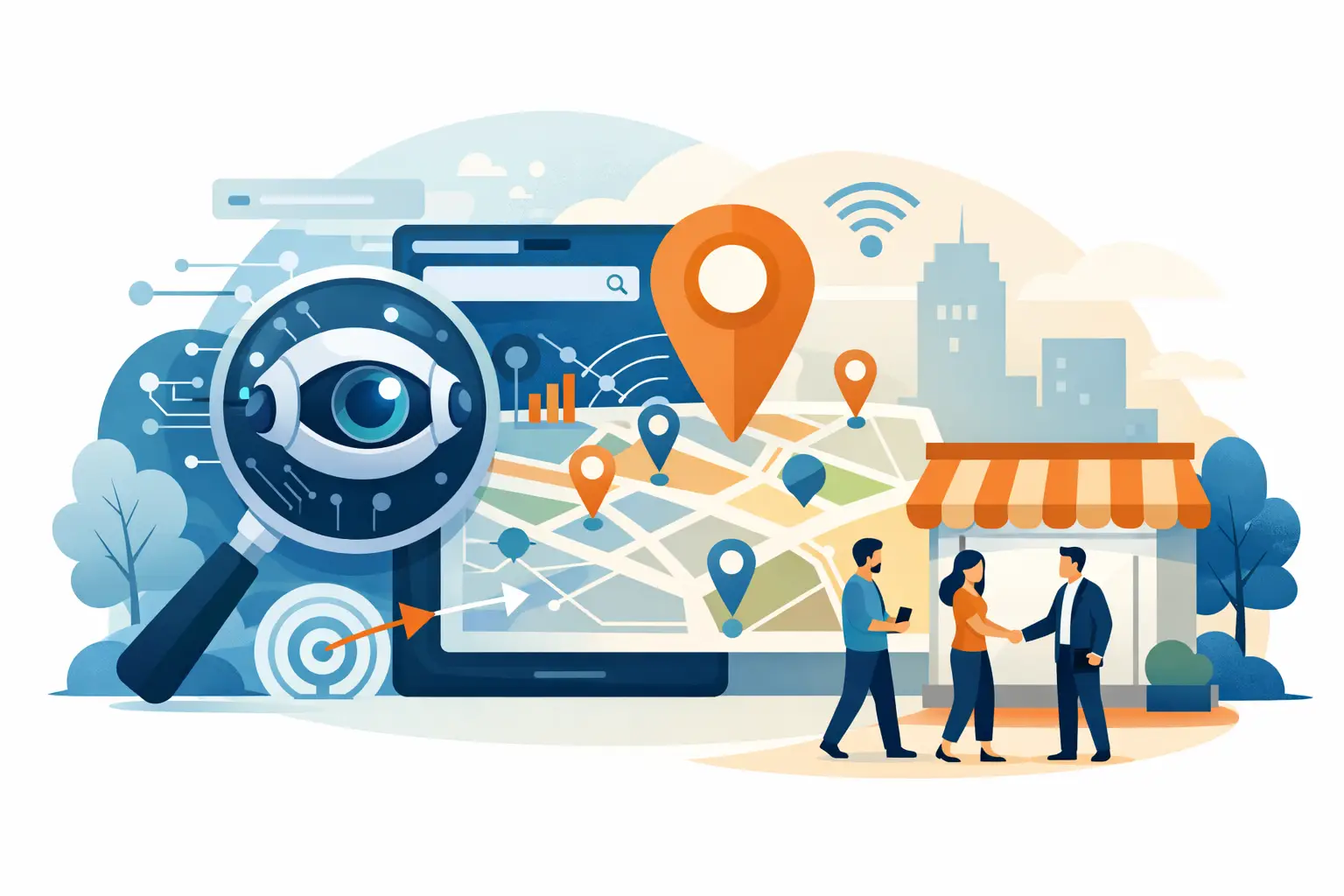
Someone in your area asks an AI tool for the best emergency plumber, solicitor, roofer or physio nearby, and your business never appears. That is the practical problem with poor AI search visibility. It is not a branding issue or a future trend to watch from a distance. It is a visibility problem that affects whether local customers find you, trust you and contact you.
For service-based businesses, this matters because search behaviour is changing without replacing Google entirely. People still use standard search results, maps and business profiles, but they are also asking AI tools for recommendations, comparisons and shortlists. Those tools pull information from websites, business listings, reviews and structured data. If your business information is weak, inconsistent or hard to interpret, you become easier to miss.
What AI search visibility actually means
AI search visibility is your ability to appear accurately in AI-generated answers, summaries and recommendations when people search for services you offer. That includes searches with local intent, such as finding a kitchen fitter in Leeds or a family solicitor in Bristol, as well as broader queries like who to call for a boiler repair.
This is not separate from SEO. It sits on top of it. AI systems still rely on the same underlying signals that help search engines understand a business - clear service pages, location relevance, crawlable content, consistent business details, authority signals and structured information.
The difference is how the answer is presented. Instead of ten blue links and a map pack, a user may get a direct response that mentions only a small number of businesses, or none by name at all. That raises the standard. It is no longer enough to rank vaguely for a broad term. Your website and wider presence need to make your business easy to interpret, easy to trust and easy to match to a specific query.
Why local businesses lose visibility in AI search
Most local businesses do not have an AI problem. They have a clarity problem.
A site may mention several services on one page without explaining each one properly. Location pages may be thin or duplicated. The Google Business Profile might use one service description while the website says something slightly different. Contact details may vary across listings. Reviews may be strong, but they do not mention the services or areas that matter most. From a machine-reading point of view, that creates uncertainty.
AI tools are built to summarise and select. If your site structure is muddled, your service offering is vague, or your location relevance is weak, you are asking those systems to guess. They usually will not.
There is also a trust issue. AI-generated responses tend to favour businesses with strong corroboration across multiple sources. If your website says one thing, your profile says another and third-party mentions are sparse, your business becomes less dependable as a source. That does not always stop you ranking in ordinary search, but it can reduce the chance of being cited or surfaced in AI-assisted results.
The local intent problem
Local searches are more specific than many businesses realise. A customer is not just looking for an electrician. They may be looking for a domestic electrician in Salford who handles rewires, has weekend availability and can provide a certificate quickly.
AI tools are often better at handling that nuance than basic search queries. That means your website content has to reflect real customer intent in more detail. Generic service copy written to fill a page will struggle. Useful, specific content built around actual jobs, service categories, locations and buyer concerns performs far better.
What improves AI search visibility
The strongest gains usually come from getting the basics right at a higher standard.
Start with your service pages. Each core service should have its own page with a clear purpose, plain language and enough detail to explain what you do, who it is for and where you provide it. If you cover multiple areas, location relevance should be handled thoughtfully, not by copying the same paragraph across twenty towns.
Next is business entity clarity. Your business name, address, phone number, opening details and service categories should be consistent across your website, Google Business Profile and other citations. This is simple work, but it matters because it reduces ambiguity.
Then there is structure. A logical site architecture helps both search engines and AI systems understand the relationship between your pages. Service pages, location pages, case studies, FAQs and contact information should not sit in isolation. They should support each other.
Schema also plays a role, but only when it reflects reality. Structured data can help define your business, services, areas served and review signals in a way machines can process more easily. It is useful, but it is not a shortcut. If the underlying page is weak, adding schema will not fix the problem.
Reviews and proof matter more than many expect
AI systems look for confidence signals. Reviews, testimonials and evidence of completed work help confirm that your business is active, credible and relevant to the service being searched.
The detail matters here. A review that says brilliant service is positive, but a review that mentions boiler installation in York, quick turnaround and tidy work gives much stronger context. The same applies to case studies and project examples on your website. Specificity improves interpretability.
How to make your website easier for AI tools to understand
A good test is this: if someone landed on your site for the first time and had ten seconds to work out what you do, where you work and why you are a credible option, could they do it?
If not, neither can a machine reliably summarising your business.
Clear headings help. So does straightforward copy that avoids jargon and inflated claims. Service pages should state the service, the area, the type of customer and the outcome. Contact pages should be easy to find. Core business details should not be buried in the footer alone.
It also helps to cover supporting questions naturally. Not every page needs an FAQ block, but your content should answer the things customers actually ask before they enquire. Price factors, response times, service boundaries, qualifications, process and common misconceptions all improve clarity.
This is where many businesses either overdo it or underdo it. Thin content gives too little information. Bloated content hides the useful parts. The right approach is focused depth - enough information to make the page genuinely useful without turning every service page into a textbook.
AI search visibility and Google Business Profile
For local businesses, your website does not work alone. Google Business Profile remains a major trust and discovery signal, and it influences how your business is understood across the wider search ecosystem.
Your primary category, secondary categories, service descriptions, business areas, imagery and review profile all contribute context. If the profile is incomplete, poorly categorised or inconsistent with the website, that weakens your overall visibility.
There is a trade-off here. Some businesses try to stuff every possible service and town into the profile. That can dilute relevance instead of improving it. It is usually better to be precise about your core services and genuine coverage areas than broad and unconvincing.
What not to do
Chasing AI search visibility with shortcuts usually creates more problems than gains.
Publishing dozens of low-quality location pages, stuffing service keywords into every heading, generating bland AI-written copy at scale and marking up pages with inaccurate schema are all common mistakes. They may create the appearance of activity, but they do not create trust or clarity.
The better approach is slower and more commercially useful. Build strong core pages. Improve technical crawlability. Align your profile and citations. Add real proof. Cover actual search intent. Then refine based on what brings enquiries, not just impressions.
That is the difference between vanity SEO and visibility that supports sales.
A practical way to think about AI search visibility
If Google and AI tools had to describe your business in one sentence, what would they say?
If that sentence would currently be vague, incomplete or slightly wrong, your priority is not more content for the sake of it. Your priority is better business definition online. For local service businesses, that means making your services, locations, expertise and credibility obvious across the website and profile footprint.
At Input Marketing, that is the practical view of AI search visibility. Not hype, not guesswork, and not a separate tactic from local SEO. It is the result of structuring your online presence so search engines and AI systems can understand your business clearly enough to put it in front of the right people.
The businesses that win here will not necessarily be the loudest. They will be the clearest, the most relevant and the easiest to trust when someone is ready to enquire.