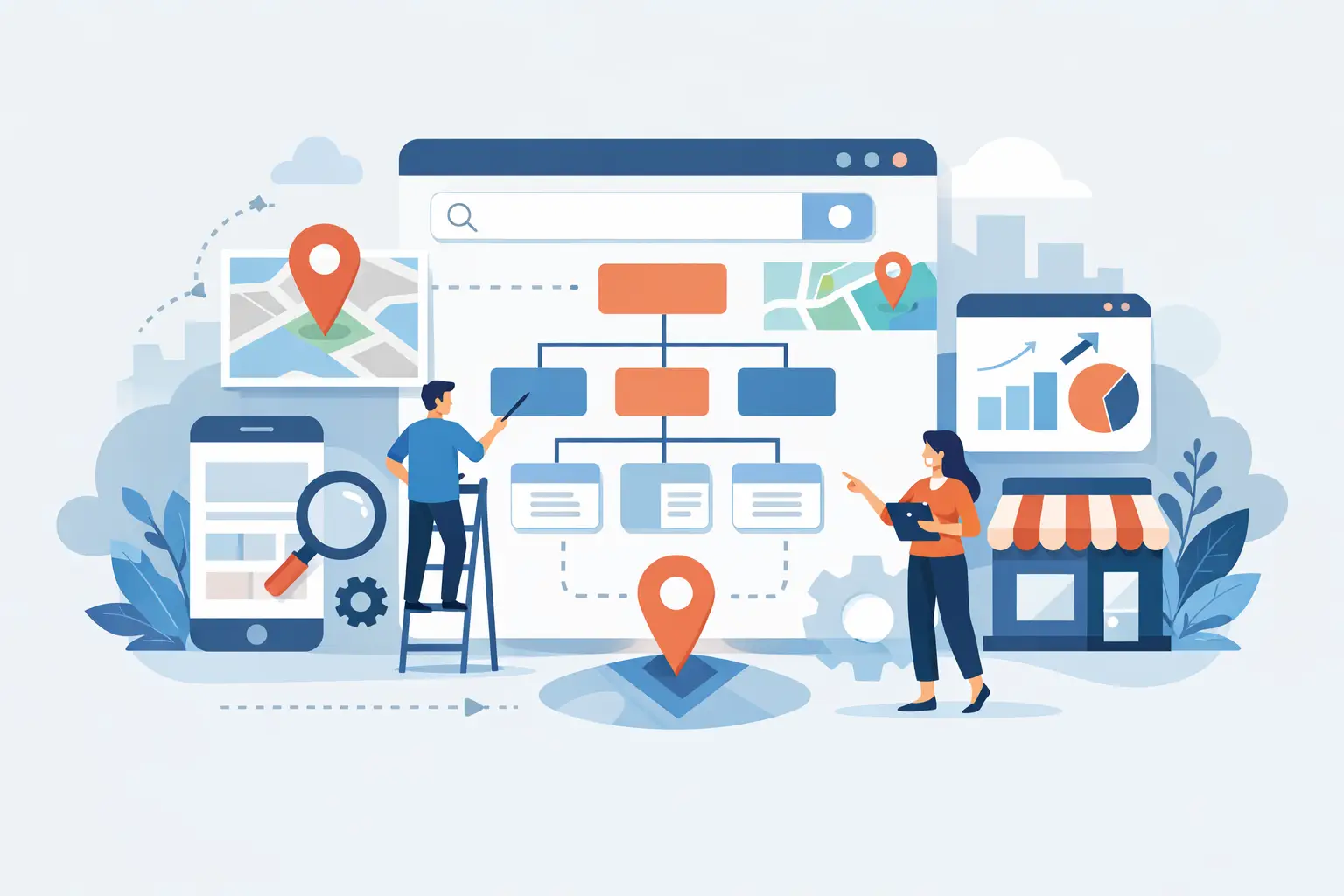
Most local SEO problems do not start with content. They start with structure.
If your website structure for local SEO is unclear, Google struggles to understand what you do, where you do it, and which pages should rank for high-value searches. The same problem now affects AI-driven search experiences as well. If your services, locations, and business details are buried, duplicated, or mixed together, visibility suffers and so do enquiries.
For service-based businesses, structure is not a technical nice-to-have. It is the framework that tells search engines and potential customers exactly how your business operates. Done well, it supports rankings in local organic search, strengthens relevance for Google Maps, and makes it easier for people to land on the right page and convert.
What good website structure for local SEO actually does
A well-structured local website makes three things obvious. First, what services you offer. Second, which areas you serve. Third, which page deserves to rank for each type of search.
That sounds simple, but many local businesses still run websites where one page tries to target every service in every town. Others create dozens of weak location pages with barely any useful content. Neither approach works particularly well over time.
Google is looking for topical clarity and location relevance. Users are looking for reassurance that you offer the service they need in the area they are searching. Your site structure needs to satisfy both.
At a practical level, that means building a site around clear service categories, clear location relevance, and straightforward internal pathways between pages. It should also support crawlability, indexing, metadata, schema, and local business signals without creating duplication.
Start with services, not blog categories
For most service-based businesses, the strongest structure starts with your commercial services. These are the pages that should attract high-intent traffic and generate calls, quote requests, and bookings.
Your core service pages should sit close to the homepage in the site hierarchy. If you are an electrician, plumber, solicitor, or roofing company, your key services need dedicated pages that clearly explain what you do, who it is for, and where it is available. Those pages should not be hidden under vague menu labels or pushed several clicks deep.
A simple structure often works best. Homepage, main service pages, and where needed, supporting sub-service pages. That gives Google a clear signal about your priorities and gives visitors a direct route to the information they need.
Blogs still have value, but they should support the commercial structure rather than compete with it. Informational articles can answer search questions, build topical depth, and support internal linking, but they should not become the main architecture of the site.
Service pages and location pages should not be the same thing
This is where many local websites lose clarity.
A service page explains the service. A location page explains your relevance to a place. When these two page types are merged badly, you usually end up with thin content that says very little about either.
If your business serves multiple areas, your structure should separate core services from location targeting. For example, a main page for boiler repair can target the service broadly, while individual location pages can target boiler repair in specific towns or districts where you actually work.
That does not mean every business needs a page for every postcode. In fact, overbuilding location pages is one of the quickest ways to create thin, repetitive content. The right approach depends on your service area, competition, and how distinct those locations are in real customer behaviour.
If you only operate from one town and nearby villages, you may need a smaller set of stronger location pages. If you cover a wider region with separate teams or offices, a deeper location structure may be justified. The test is simple: can each page offer genuinely local, useful, differentiated information?
The ideal local site hierarchy
For most businesses, the structure should be easy to follow.
Your homepage should establish the business, core services, main location, and primary trust signals. From there, users and search engines should be able to reach your service pages quickly. If location pages are needed, they should sit in a logical section and connect clearly back to relevant services.
A typical structure might look like this in practice: homepage, service pages, location pages, and then supporting content such as case studies, FAQs, and blog articles. In some cases, service-location pages are useful, but only for high-value combinations where search demand and conversion potential justify a dedicated page.
That last point matters. A page for emergency plumber in Leeds may make sense if it reflects real demand and a real service area. Creating fifty near-identical pages for every nearby town usually does not.
Navigation should reflect how customers search
Your main navigation is not just a design feature. It is an SEO signal and a conversion tool.
If customers search by service first, your navigation should lead with services. If location matters heavily, such as for estate agents or legal firms with multiple offices, location access may need stronger prominence. The right balance depends on how people choose suppliers in your sector.
What you want to avoid is clever wording that hides commercial intent. Labels such as Solutions, Expertise, or What We Do often make sense internally but do less for search clarity and user confidence. Direct terms such as Plumbing Services, Areas We Cover, or Blocked Drains are usually stronger.
Good navigation also reduces orphan pages and helps spread authority through the site. If a key service page is missing from menus and internal links, you are making it harder for search engines to treat it as important.
Internal linking is where structure becomes useful
A sensible hierarchy is only part of the job. Internal linking is what turns that hierarchy into a working SEO system.
Your homepage should link to key service and location pages. Service pages should link to relevant locations where appropriate. Location pages should link back to core services. Supporting articles should feed authority into commercial pages rather than simply link sideways to other blog posts.
This helps search engines understand relationships between topics, services, and places. It also improves the user journey. Someone landing on a page about commercial roofing in Manchester should be able to move easily to related service details, trust content, and a contact path.
Anchor text matters here, but it should stay natural. Repeating exact-match phrases in every link looks forced. A mix of clear, descriptive wording usually works better.
Local landing pages need substance
A location page should do more than swap out the town name.
If you want a page to rank and convert, it needs real local relevance. That could include the services offered in that area, examples of work completed nearby, response times, local testimonials, parking or coverage details, and references to how customers in that location typically search or buy.
The same standard applies to AI search visibility. AI systems are better at detecting whether a page contains useful, coherent information or just templated repetition. Pages that clearly describe your service offering, business context, and local relevance are easier for those systems to interpret accurately.
This is also where schema and business consistency help. Your page content, metadata, headings, and structured data should point in the same direction. Mixed signals create confusion.
Technical structure still matters
Local SEO is not just about page topics. Technical clarity supports everything else.
Your URLs should be clean and descriptive. Your sitemap should reflect real priorities. Canonicals should prevent duplication where similar pages exist. Breadcrumbs can strengthen hierarchy. Mobile usability matters because local searches often happen on the move, and slow pages lose leads quickly.
You also need to think about indexation. Not every page deserves to be indexed. Filter pages, tag pages, and low-value duplicate pages can dilute the strength of your site if left unmanaged.
For businesses that care about Google Maps visibility as well as organic search, website structure also needs to support your Google Business Profile. Your primary website link, service references, location references, and NAP consistency should reinforce the same business story.
Common mistakes that weaken local performance
The biggest issue is usually confusion. One page targets too many terms, too many locations, or too many audience types. That weakens relevance and makes conversion harder.
Another common mistake is creating location pages without enough local value. Google has become much better at spotting pages built purely to capture search traffic. If a page adds nothing beyond a place name, it is unlikely to perform well for long.
Some businesses also overinvest in blog content while their service architecture remains thin. Traffic is not the goal. Qualified local enquiries are. If your best service pages are weak, no amount of general content will fully solve that.
Finally, many websites ignore future-facing search behaviour. If your site structure is messy, AI tools are less likely to interpret your business correctly. That matters more now than it did even a year ago.
Build for clarity first, then scale
The strongest local websites are rarely the most complicated. They are the clearest.
Start by defining your core services, your real service areas, and the pages that can genuinely win business. Build the structure around those priorities. Then strengthen it with internal links, local detail, technical clarity, and supporting content that answers real search intent.
That is the approach Input Marketing uses because it aligns rankings with revenue, not vanity metrics. A clear structure gives Google confidence, helps AI tools understand your business, and gives local customers a faster route to contacting you.
If your site currently feels scattered, the fix is not usually more pages. It is a better framework. Get the structure right, and the rest of your local SEO has something solid to build on.