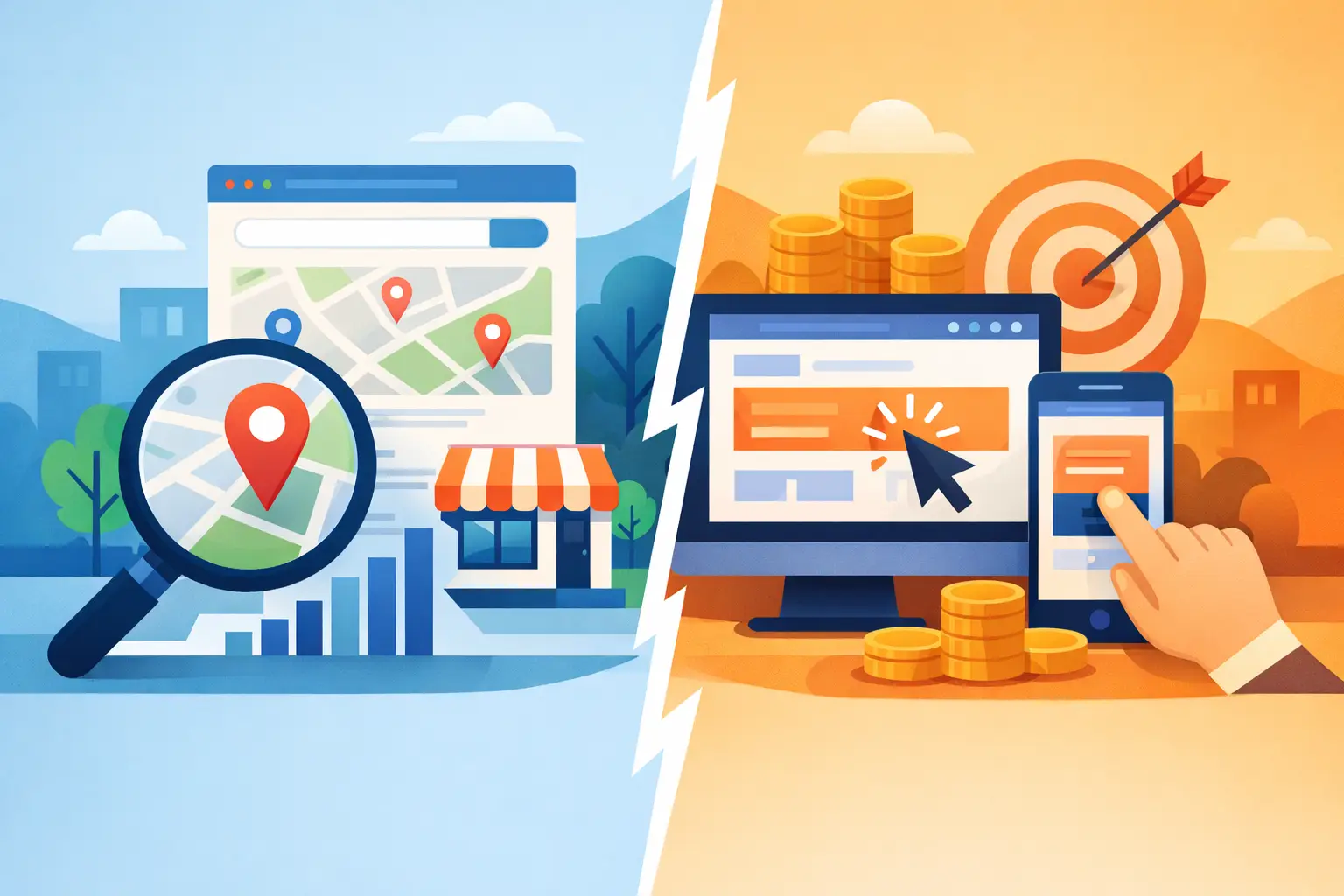
A lot of local businesses ask the same question after burning through ad spend or waiting months for rankings to move: should we put more money into Google Ads, or should we focus on local SEO? When you compare local SEO vs PPC properly, the answer is rarely as simple as choosing the faster option or the cheaper one. It comes down to how your customers search, how competitive your market is, and how quickly you need enquiries.
For a service-based business, this decision affects more than traffic. It affects whether your business appears in the local pack, whether your Google Business Profile pulls in calls, whether your service pages match local intent, and whether your marketing still works when you stop spending. That is why this is not just a channel choice. It is a visibility strategy.
Local SEO vs PPC: the core difference
Local SEO helps your business appear organically in Google Search, Google Maps, and local results when people search for services in a specific area. That includes your Google Business Profile, your website pages, your local landing pages, your reviews, your citations, and the technical structure that helps search engines understand what you do and where you do it.
PPC, usually through Google Ads, puts your business in paid positions for targeted searches. You bid on keywords, write ad copy, direct visitors to landing pages, and pay when someone clicks. If the campaign is set up well, PPC can generate leads quickly. If it is set up badly, it can drain budget just as quickly.
The real distinction is this: local SEO builds visibility that can keep producing leads over time, while PPC rents visibility for as long as you keep paying.
When PPC makes sense
PPC is often the right choice when speed matters. If you have just launched, entered a new area, or need leads this month rather than next quarter, paid search can put you in front of active buyers quickly. That matters for businesses with immediate capacity to fill, seasonal demand, or a short-term push around a profitable service.
It also works well when search intent is very clear. If someone searches for an emergency plumber in Leeds or boiler repair near me, that person may be ready to call now. A well-targeted ad with a strong landing page can convert that traffic fast.
That said, PPC works best when the numbers are under control. Cost per click can be high in competitive sectors such as legal, home services, and financial services. If your website is weak, your location targeting is broad, or your landing page does not match the search, you can end up paying for clicks that never turn into enquiries.
PPC also needs active management. Keywords need refining, wasted spend needs cutting, ad copy needs testing, and conversion tracking needs to be accurate. It is not a switch you turn on and leave alone.
When local SEO makes sense
Local SEO is usually the stronger long-term play for businesses that want consistent visibility in a defined service area. If people search for your service every month, and your business depends on local discovery, SEO gives you a way to build an asset rather than fund a recurring bill.
Strong local SEO improves more than rankings. It helps your business show up in map results, creates clearer service and location signals across your website, and supports trust through reviews, accurate business information, and useful content. That is particularly important for businesses where customers compare a few local options before making contact.
It also tends to improve lead quality over time. Someone who finds a well-optimised service page, sees a credible Google Business Profile, checks reviews, and understands your coverage area is often better qualified than someone who clicked an ad out of curiosity.
The trade-off is speed. Local SEO rarely delivers overnight, especially in competitive towns and cities. It takes time to improve technical foundations, build location relevance, optimise pages, strengthen profile signals, and earn visibility. But once those pieces are working together, the results are often more stable and more cost-efficient than paid traffic alone.
Cost: upfront spend versus ongoing dependency
Businesses often assume SEO is cheaper and PPC is expensive. That is too simplistic.
PPC has direct, visible costs. You pay for every click, and in some industries those clicks are not cheap. The benefit is predictability. You can set a budget, estimate traffic, and scale up or down quickly. The downside is dependence. Once the budget stops, the visibility usually stops as well.
Local SEO usually involves upfront investment in strategy, website improvements, content, profile optimisation, and technical fixes. The costs are less tied to each visitor and more tied to building the system properly. Done well, that work can keep generating enquiries without charging you for every click.
The better question is not which channel costs less. It is which channel gives you a better cost per qualified enquiry over time.
Lead quality and intent
Not all clicks are equal, and not all rankings produce good leads.
PPC can attract high-intent users, especially for urgent or transactional searches. But paid traffic can also include weaker clicks if match types are too broad, ad copy is vague, or the campaign targets the wrong areas. A lot depends on campaign quality.
Local SEO often performs well for trust-led services, where people want reassurance before getting in touch. Organic results and map listings can feel more credible than ads, particularly when the business has strong reviews, a clear service offering, and a website that matches local search intent.
For many service businesses, the best leads come from a combination of the two. PPC captures immediate demand. Local SEO strengthens trust, improves discovery across more searches, and supports users who are still comparing options.
Local SEO vs PPC for different stages of growth
If you are a newer business with little online presence, PPC can help you generate early data and leads while SEO foundations are being built. You can learn which services convert, which locations perform best, and what language customers respond to.
If you are established but underperforming in local search, local SEO is often the bigger missed opportunity. Many businesses already have enough demand in their market. The problem is weak page targeting, poor Google Business Profile optimisation, thin service content, or technical issues affecting crawlability and indexing.
If you operate in a highly competitive area, relying on one channel alone is risky. Ads may become too expensive, and organic growth may take longer. In that case, a blended strategy is usually more commercially sensible.
Why local SEO often supports PPC performance
This is where many businesses look at the channels separately when they should not.
A strong local SEO setup often improves PPC results. Better service pages improve landing page relevance. Clear location signals help match intent. Faster websites improve user experience. Stronger metadata and page structure support quality scores and conversions. Reviews and a credible Google Business Profile can also increase trust after someone clicks an ad.
The reverse is also true. PPC data can improve SEO. Paid campaigns show which services attract clicks, which areas convert, and which wording drives enquiries. That can inform page titles, service page structure, and local content planning.
The smartest approach is not a turf war between channels. It is using each one where it does its job best.
How to choose between local SEO and PPC
If your business needs leads quickly, PPC should usually play a role. If your business needs sustainable visibility in Google Search and Maps, local SEO should usually be the foundation. If budget is tight, the decision comes down to timing, margins, and how much work your current website and profile need.
Ask a few practical questions. Do you need enquiries this month, or are you trying to lower lead acquisition costs over the next year? Are your click costs manageable? Is your Google Business Profile already active but under-optimised? Does your website clearly target your core services and locations? Are people searching for what you offer in your area every week?
If the answers point to strong local demand and weak organic visibility, local SEO is likely the better investment. If the market is active and you need immediate traction, PPC can fill the gap while SEO builds.
For most service-based businesses, the strongest option is not local SEO or PPC in isolation. It is a commercially sensible mix, with local SEO building durable visibility and PPC covering short-term demand, testing offers, and protecting key search terms.
At Input Marketing, that is usually where the conversation ends up - not with a generic channel recommendation, but with a search strategy built around how local customers actually find and choose a business.
If you are deciding where to put budget next, do not start with the platform. Start with the enquiry. Work backwards from the searches that bring in real customers, then invest in the channel mix that gives those searches the best chance of turning into revenue.